Field Data Experts
Educational Enjoyment
At Eco-Explore, we're more than just educators; we're life scientists passionate about the environment and the natural world. We understand that for many aspiring and current ecologists, the world of data analysis can be as challenging as the terrain we wish to protect. That's why our specialised training programs are crafted to empower you with the analytical tools necessary for ground-breaking work in science and conservation. Every course you take with us not only sharpens your professional edge but also supports the environment directly. Profits from our programs are reinvested into local conservation initiatives—your growth aids the growth of our planet.
Check out our projects to see the tangible impacts of your contributions and how Eco-Explore is turning data analysis into a force for ecological advancement.
Our Courses

Introduction to Data Analysis with R
4 DAY COURSE | Wednesdays 09:00am-12:00pm
Dates Available:
Fee: £220 + VAT (£264)
Learn how to handle, analyse and visualise data using R, one of the most powerful and widely used tools in scientific research, ecology, environmental consultancy and data science.
This practical, hands-on course is designed for complete beginners and assumes no prior experience with R. Through a combination of live online teaching, guided exercises, supporting resources and independent practice materials, you will develop the skills and confidence to undertake your own data analysis projects.
Taught over four mornings, each session includes live tutor-led demonstrations and opportunities to ask questions, work through exercises and discuss analytical approaches. Between sessions, participants will have access to additional learning materials, worked examples and exercises to reinforce their understanding at their own pace.
By the end of the course, you will be able to import, manage, analyse and visualise data in R, understand the principles behind common statistical approaches, and apply these techniques confidently to your own research or professional projects.

Advanced Data Analysis in R
5 DAY COURSE | Wednesdays 09:00am-12:00pm
Dates Available:
Fee: £275 + VAT (£330)
Ready to take your statistical analysis to the next level?
This advanced course is designed for participants who already have experience using R and are familiar with linear models but wish to develop a deeper understanding of modern statistical approaches used in research, environmental science, ecology, healthcare and applied data analysis.
Through a combination of live online teaching, practical exercises, worked examples and self-paced learning materials, you will learn how to analyse more complex datasets and address the challenges commonly encountered in real-world research and professional practice.
Taught over five mornings, each session combines tutor-led demonstrations with hands-on exercises, allowing participants to build and interpret advanced statistical models using R. Participants are encouraged to bring their own datasets and analytical questions for discussion throughout the course.
By the end of the course, you will be able to build, interpret and critically evaluate a range of advanced statistical models in R, understand their assumptions and limitations, and confidently apply them to your own research or professional projects.
Prerequisites: Participants should be comfortable using R and RStudio and have a basic understanding of linear modelling. Completion of our Introduction to Data Analysis with R course, or equivalent experience, is recommended.
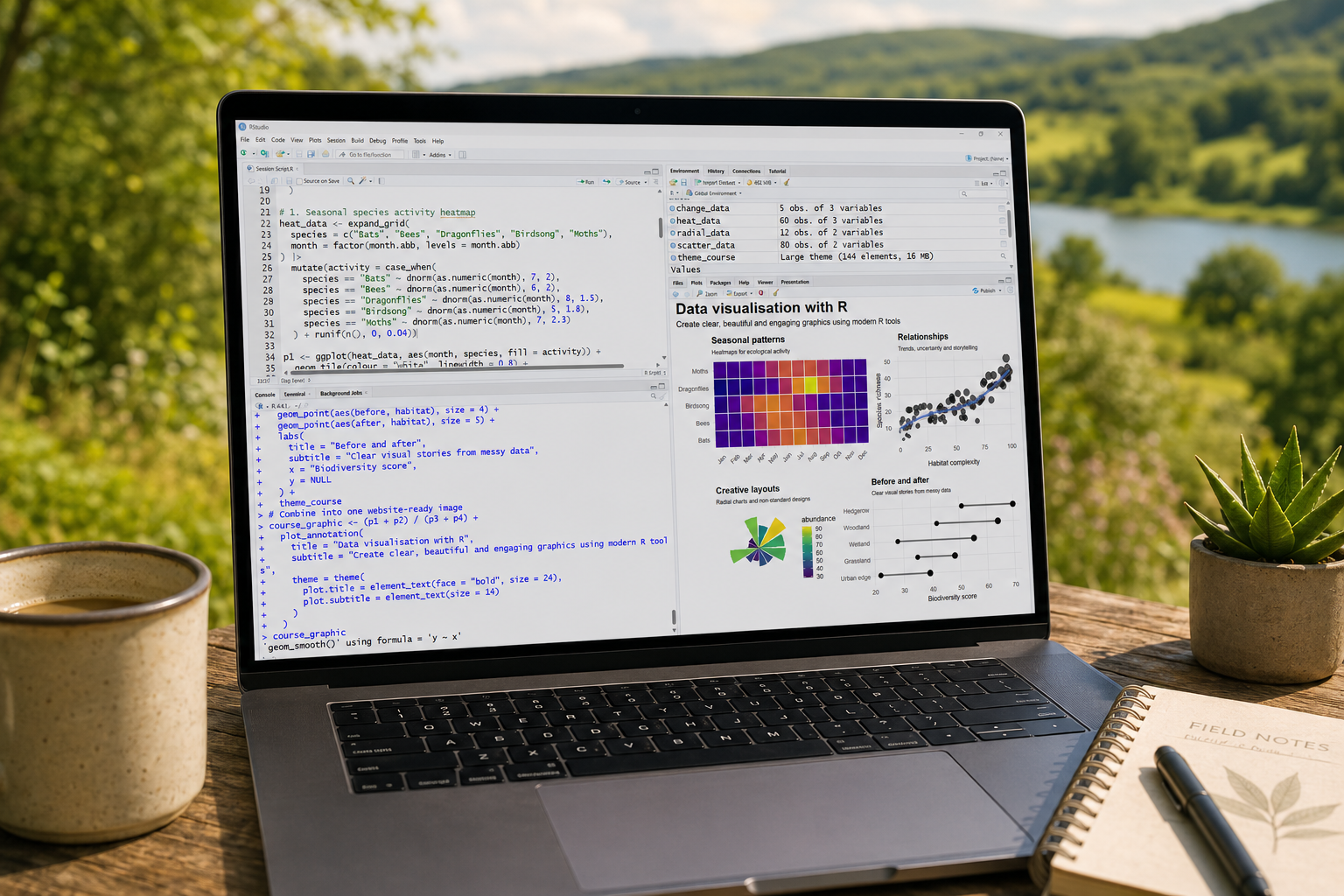
Data Visualisation with R
2 DAY COURSE | Tuesdays 09:00am-12:00pm
Dates Available:
Fee: £110 + VAT (£132)
Learn how to create clear, professional and publication-quality graphics using R.
Effective data visualisation is an essential skill for researchers, consultants, analysts and anyone who needs to communicate evidence clearly. This practical course focuses on transforming data into informative and visually appealing figures using the powerful ggplot2 package, alongside a range of complementary visualisation tools within R.
Through live online teaching, guided exercises and worked examples, participants will learn how to design figures that communicate key messages, avoid common pitfalls, and meet the standards expected in scientific publications, consultancy reports and professional presentations.
Taught over two mornings, each session combines tutor-led demonstrations with hands-on exercises, allowing participants to build a portfolio of visualisation techniques that can be applied immediately to their own work.
By the end of the course, you will be able to produce clear, professional and visually engaging graphics in R, select appropriate visualisation techniques for different types of data, and communicate analytical results more effectively to a wide range of audiences.
Prerequisites: Participants should have a basic familiarity with R and RStudio. Completion of our Introduction to Data Analysis with R course, or equivalent experience, is recommended.

“Incredibly knowledgeable teachers with amazing experience of R”
“Excellent step-by-step walkthroughs and explanation of key concepts!”
“Just too good to be true! Already applying these codes to my data set”
“Had not used R before and stats was very rusty, Feel that I can now use R and its similarities/differences to Python and how much better it is a graph visualisation.” –
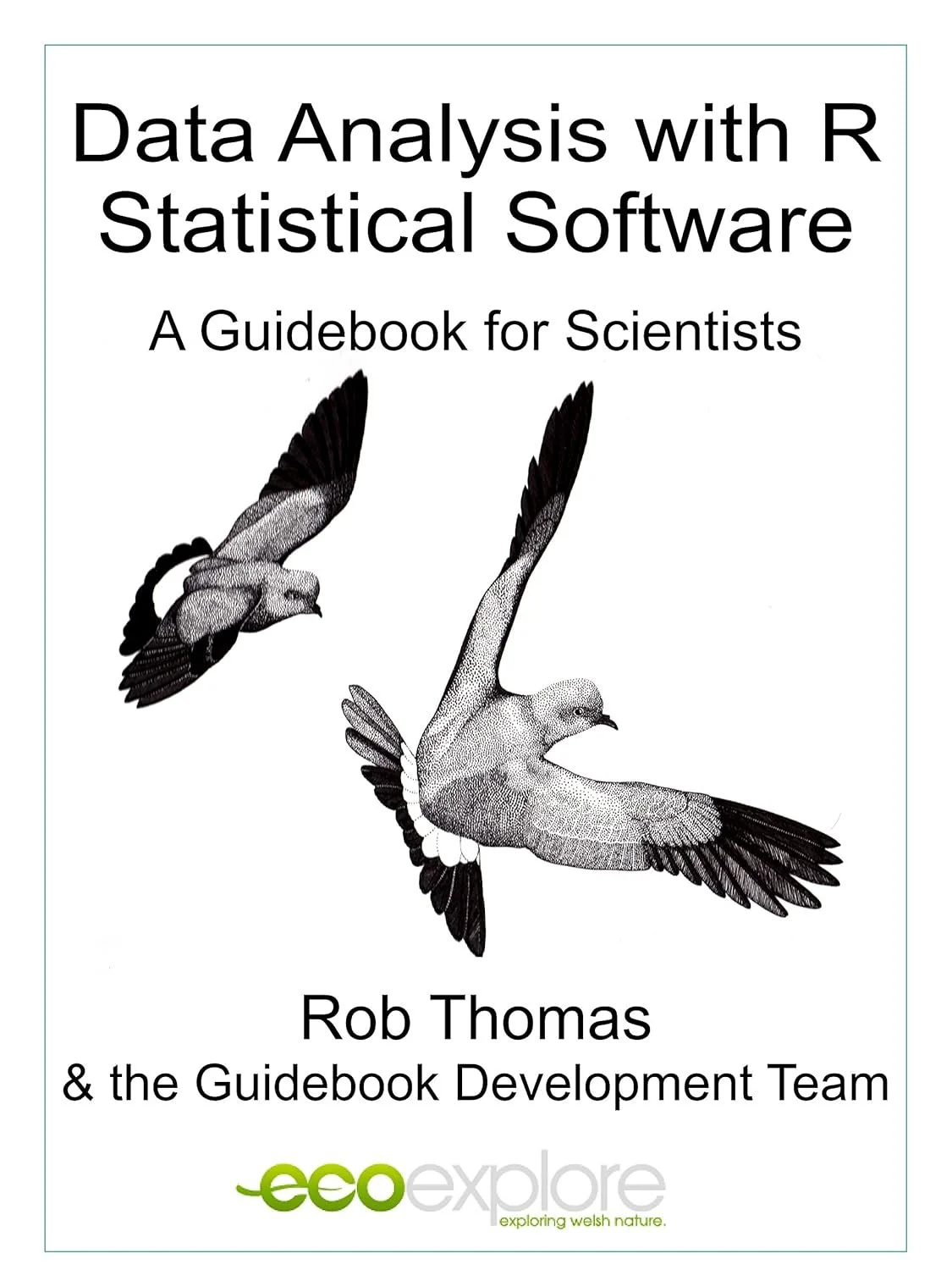
Guidebook
Our 150-page guidebook is designed to help you quickly to become familiar with R and to explore its potential as a powerful tool for analysing your data, whatever your field of research. The guidebook covers the simple things (getting started with R, plotting graphs, simple statistical tests) as well as more complex topics (e.g. GLM, GAM, GLMM, multivariate data exploration, time-series and survival analysis, spatial analysis).
Trusted by